
Do Massage Guns Actually Work? Percussion Therapy Explained
Percussion massagers went from physio clinics to every gym bag in about five years. The research is more modest than the marketing, here is what they genuinely help with, what they do not, and where you should never use one.
SHOPTHIVA Editors
Quick takeaways
The evidence supports two things: short-term reduction in delayed-onset muscle soreness, and an immediate increase in range of motion. It does not break down scar tissue or flush lactic acid. Those claims are marketing; lactate clears on its own within about an hour of stopping. Two minutes per muscle group is the working dose used in most studies, longer is not better. Never use one on bone, joints, the neck, or an acute injury. Percussion is for muscle bellies only.
What percussion therapy actually does
A massage gun drives a head rapidly into soft tissue, typically 1,800 to 3,200 percussions per minute, at a shallow depth. The mechanism is largely neurological rather than mechanical. Rapid vibration floods the area with sensory input, which reduces how much pain the nervous system reports from that region, and appears to lower the tone of an over-active muscle.
The most consistent finding in the literature is on delayed-onset muscle soreness. Treating a muscle group for a couple of minutes after exercise reliably reduces reported soreness over the following 24 to 72 hours compared with doing nothing. The effect is real but moderate, it makes the day after a hard session more comfortable, it does not eliminate it.
The second reliable finding is range of motion. A short treatment before activity increases how far a joint will move, without the temporary strength loss that static stretching can cause. That makes it more useful as part of a warm-up than most people realise.
What it does not do
It does not flush lactic acid. Lactate is cleared by normal metabolism within roughly 30 to 60 minutes of stopping exercise, long before next-day soreness appears. The two are unrelated, despite how often they are mentioned together.
It does not break up scar tissue or adhesions. The forces involved are nowhere near what would be needed to remodel connective tissue, and if they were, the process would not be comfortable.
It does not speed up injury healing. For a strain or a tear, percussion over the injured site can make things worse. Soreness and injury are different problems.
How to use one properly
Keep it moving. Park the head on one spot and you get numbness and bruising rather than benefit, glide slowly along the length of the muscle, roughly 2-3cm per second.
Let the weight of the device do the work. Pressing hard does not increase the effect; it just increases the risk of bruising. If the motor is bogging down, you are pushing too hard.
Two minutes per muscle group is the dose used in most of the research. For a warm-up, 30 to 60 seconds is enough to get the range-of-motion effect.
Muscle bellies only. Stay off bone, tendon insertions, joints, the front and sides of the neck, the kidneys and the abdomen. Never use one over a fresh injury, a varicose vein, or an area with reduced sensation.
Which specifications matter
Amplitude, then stall force, then speed. Amplitude is how far the head travels, around 10mm is typical for a portable unit and is what determines how deep the effect goes. Stall force is how much pressure it takes before the motor stops; higher means it keeps working when pressed into a large muscle.
Speed range is less important than the marketing suggests. Anything offering a spread from roughly 1,800 to 3,000 percussions per minute covers everything you need, and most people settle on one or two settings and never change them.
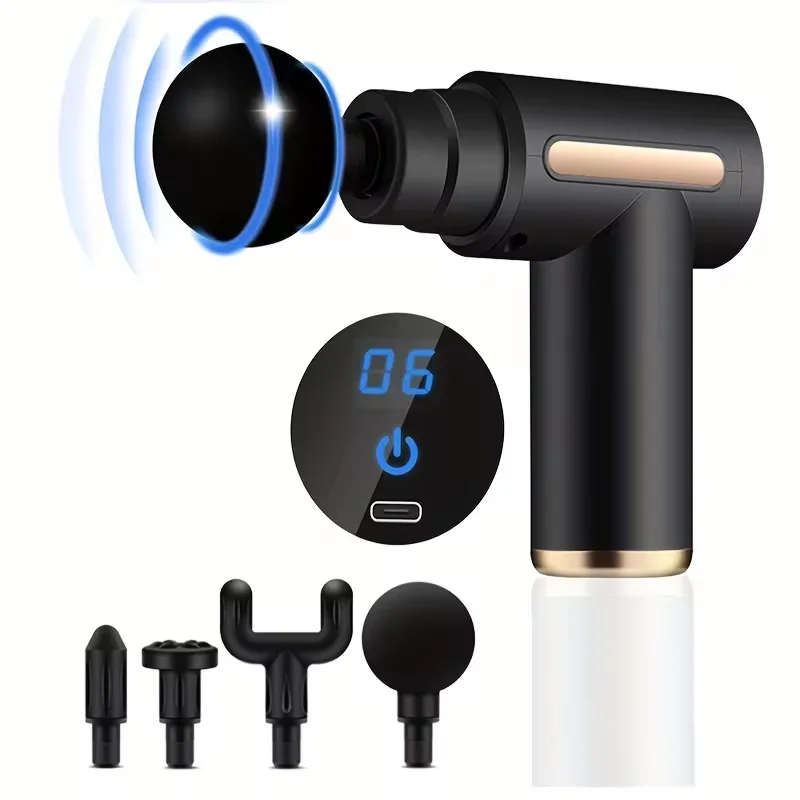
Heads. The ball head does 90% of the work. A flat head suits broad areas like the quads, and a fork head is for either side of the spine, never on it. The bullet head is easy to injure yourself with and is best left alone unless someone has shown you how.
Noise and weight matter more than the spec sheet implies. A device that is unpleasant to hold or too loud to use in front of the television gets left in a drawer.
Who it is worth it for
If you train regularly and the day-after stiffness is what stops you training again, a percussion massager is one of the few recovery gadgets with genuine evidence behind it. It is also the most convenient way to get a range-of-motion boost before a session.
If you are looking for a treatment for an actual injury, or for pain that has lasted more than a couple of weeks, this is not the tool, that is a conversation with a physiotherapist or GP.
Featured in this article
Frequently asked questions
Do massage guns really reduce muscle soreness?
The evidence supports a moderate reduction in delayed-onset muscle soreness when a muscle group is treated for about two minutes after exercise. It makes the following days more comfortable rather than removing soreness entirely.
How long should I use a massage gun for?
About two minutes per muscle group for recovery, and 30-60 seconds as part of a warm-up. Longer sessions do not improve the result and increase the chance of bruising.
Where should you never use a massage gun?
On bone, joints, tendon insertions, the front or sides of the neck, the abdomen and kidneys, over a fresh injury, over varicose veins, or anywhere with reduced sensation. Use it on muscle bellies only.
Do massage guns break down lactic acid?
No. Lactate clears through normal metabolism within roughly an hour of finishing exercise, well before next-day soreness starts. The claim is common in marketing but the two are not related.
Product gallery
Further reading