






Do You Really Need a Luggage Scale? What UK Travellers Should Know
Overweight suitcase fees can cost more than your flight. A portable luggage scale is a small investment that pays for itself on the first trip. Here is what to look for.
SHOPTHIVA Editors
Why a Luggage Scale Saves You Money
Airlines are stricter than ever about cabin and hold luggage weights. EasyJet, Ryanair, and Wizz Air all charge per kilo over the limit, and the fee is usually higher at the airport than online. A portable luggage scale that costs less than a single overage charge pays for itself on the very first trip.
If you have ever stood at check-in rearranging jumpers from your case into a carrier bag, you know the feeling. A scale takes the guesswork out of packing. Weigh once at home, redistribute if needed, and walk into the airport knowing you are under the limit.
The scale is not just for flights. Ferry operators, train luggage racks, and even some coach services have weight rules. If you travel regularly, even within the UK, a luggage scale belongs in your essentials kit alongside your passport holder and travel adapter.
What Makes a Good Portable Luggage Scale
Accuracy is the only reason you are buying one, so it matters most. Look for a scale that reads to the nearest 10 grams. Cheaper models round to the nearest 100 grams, which is a wide margin when airlines count every kilo.
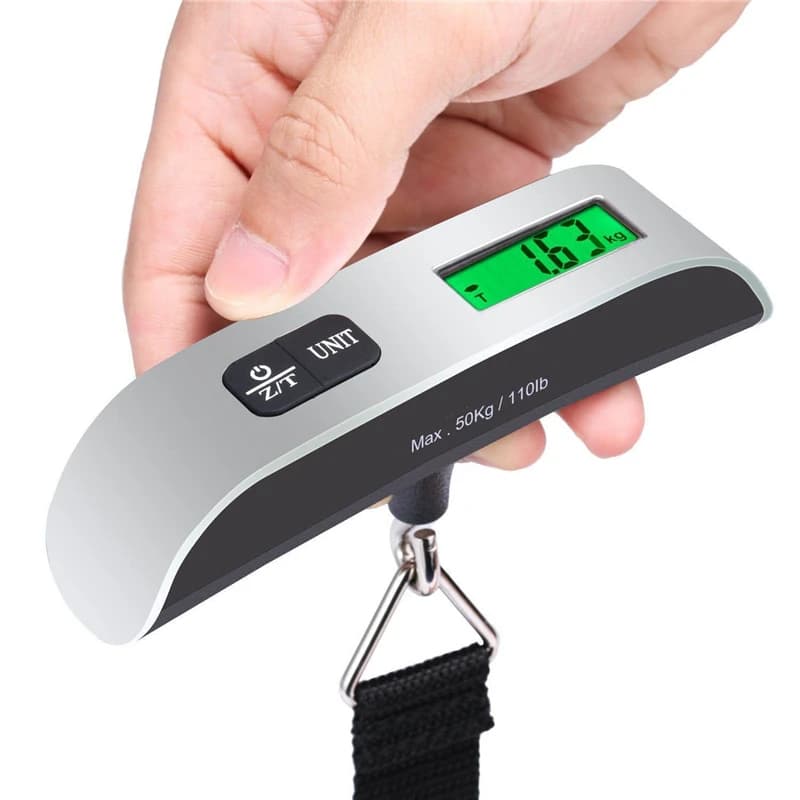
LCD display size matters too. A clear backlit screen means you can read the weight while the scale is hooked onto a heavy case at arm's length, squinting at tiny digits defeats the point. Models with a tare function let you weigh just your bag, not the strap you are hanging it from.
Weight capacity should be at least 50 kg. Most suitcases are well under that, but a 50 kg range gives you headroom for oversized duffel bags and moving boxes. The scale itself should weigh under 100 grams so it does not add to your baggage allowance.
Build quality comes down to the hook and the body. A metal hook is more durable than plastic, and a rubberised grip is easier to hold when you are lifting 23 kg of holiday shopping. If the scale feels flimsy, the internal sensor probably is too.
How to Use a Luggage Scale Properly
Hook the scale onto the suitcase handle, lift the case off the floor, and hold steady until the reading locks on the display. Most scales beep or flash when the weight stabilises. If you lift unevenly or swing the bag, the reading will bounce, a quick, smooth lift gives the most accurate number.
For cabin bags, weigh the bag empty first if you are close to the limit. This tells you how much weight you have left for souvenirs on the way back. For hold luggage, weigh after you have packed everything, shoes and toiletries are where the hidden weight lives.
Always weigh with the same scale each time. Different scales can vary by up to half a kilo, and that margin matters on a 20 kg limit. Keep your scale in your suitcase so you can weigh again before the return journey.
Featured in this article
Frequently asked questions
Are portable luggage scales accurate?
Most digital luggage scales are accurate to within 50 grams when used correctly. Look for models that read to 10 gram increments for the best precision. Always lift smoothly and hold steady for an accurate reading.
Can I use a luggage scale for carry-on bags?
Yes, a luggage scale works for any bag with a handle or strap. Weigh your cabin bag before you fly to avoid surprise fees at the gate, where budget airlines are especially strict about 10 kg limits.