

Eyeliner Brush vs Eyebrow Brush: What's the Difference and Do You Need Both?
Angled makeup brushes are some of the most versatile tools in a makeup kit, but the difference between an eyeliner brush and an eyebrow brush confuses plenty of beginners. Here is what each one does, what to look for when buying, and how one well-made angled brush can handle both jobs.
SHOPTHIVA Editors
Quick takeaways
The main difference between the two brushes is bristle stiffness: eyeliner brushes have finer, more flexible tips for creating fluid lines, while eyebrow brushes are slightly stiffer to pack powder or pomade into brow hairs.
A quality angled flat brush with synthetic bristles can do both jobs well. This saves space in your makeup bag and costs less than buying two separate tools.
What matters more than the price is the precision of the edge. The thinner and sharper the tip, the cleaner your line. A brush with loose or splayed bristles will frustrate you no matter how much you paid for it.
Clean your brush after every use with mild soap and lukewarm water. Reshape the bristles while damp and lay flat to dry. This keeps the edge sharp and prevents product buildup.
The real difference between eyeliner and eyebrow brushes
If you have ever stood in the makeup brush aisle squinting at two nearly identical angled brushes and wondered what the difference is, you are not alone. Both are small, flat, and cut at an angle. But they are built for different jobs.
An eyeliner brush is designed for fluid, controlled strokes. The bristles are finer and more flexible so they can pick up gel or liquid liner and drag it across the lash line without skipping. The tip comes to a very thin point. If you push too hard, the bristles give way rather than digging into your eyelid.
An eyebrow brush has a similar angled shape but with slightly firmer, denser bristles. It is meant to pick up powder or pomade and deposit it in short, hair-like strokes. The stiffness helps you control exactly where the pigment goes, which matters when you are filling in sparse patches.
In practice, a well-made angled brush with synthetic bristles can do both. Use the thin edge for liner work and the flat side for brows. The key is cleaning it between products unless you want greyish-brown eyeliner.
What makes a good angled brush
Not all angled brushes are equal, and a bad one will make even easy techniques feel impossible. Here is what to look for, whether you are spending £5 or £25.
Bristle material. Synthetic bristles (usually taklon) are the standard now. They hold their shape well, do not absorb product the way natural hair does, and are easier to clean. For gel and liquid products, synthetic is actually better than natural hair because it does not soak up the formula.
The ferrule. That is the metal band connecting the bristles to the handle. It should be tight against the handle with no wobble or gap. A loose ferrule means water and product get inside, which weakens the glue and leads to shedding bristles within weeks.
Handle length. Short handles give you more control for detail work. A brush that is too long becomes harder to steer precisely, especially near the lash line. The sweet spot is roughly 15 cm total length, which fits comfortably between your fingers.
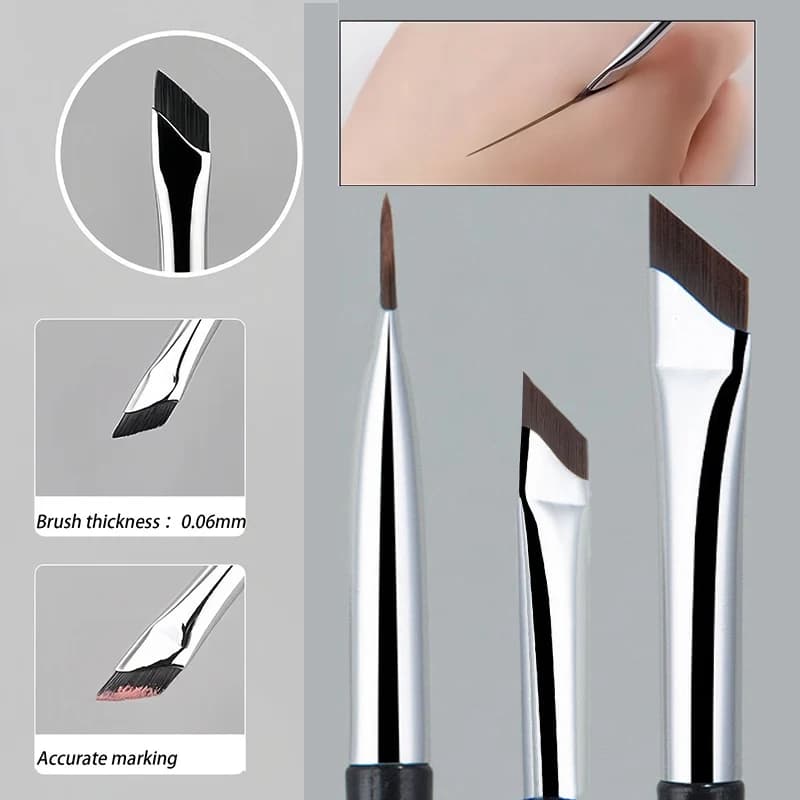
The edge. Hold the brush up to the light and look at the tip. A good brush comes to a clean, sharp point with no stray bristles. If the edge looks rounded or fluffy out of the box, it will only get worse with use.
How to use one brush for both liner and brows
Using a single angled brush for both jobs is straightforward once you know the technique. The trick is angle control and product placement.
For eyeliner, load just the very tip of the brush with gel liner. Hold the brush almost parallel to your lash line and use short, connecting strokes rather than trying to draw one continuous line. The flat side of the brush should face your lashes, letting the thin edge do the drawing. If you are new to gel liner, rest your elbow on a table for stability.
For eyebrows, pick up a small amount of powder or pomade on the flat side of the brush. Use the angled edge to draw fine, upward strokes that mimic natural brow hairs. Start at the arch (where brows are naturally densest) and work outward to the tail, then use whatever is left on the brush for the inner corner so it looks softer.
Between products, wipe the brush on a clean tissue until no pigment transfers. This takes about ten seconds and stops your liner from turning brown or your brows from going black. Deep-clean the brush with mild soap and lukewarm water once a week. Avoid getting water into the ferrule, and always reshape the bristles while damp so they dry in the right position.
Is a £12 precision brush worth it?
You do not need to spend £30 or more on a single angled brush to get good results. The makeup brush market has changed dramatically in the last decade. Synthetic bristle manufacturing has improved to the point where a well-made £12 brush often performs close to a premium one for daily use.
The Upgrade Blade Eyeliner Brush available at SHOPTHIVA for £12.99 is a good example. It uses synthetic taklon bristles with a tight ferrule and a short handle for precision control. It comes in two variants (eyeliner and eyebrow), so you can pick the one that matches your primary use, or get both for under £25 total.
Honest trade-off: this is not a MAC 210 or a Sigma E06. It will not last five years of daily professional use. But for someone building a home kit or replacing a worn-out brush, it does the job well. The bristles hold their shape through repeated washing, the edge stays sharp enough for clean lines, and the price means you can replace it without guilt when it eventually loses its edge, which all brushes do.
If you are a beginner who just wants one reliable tool for both eyeliner and brows without overthinking it, this is the right category of brush. Spend the money you save on better eyeliner instead. Related reading: What Is a Fan Makeup Brush? How to Use One for Hig · Why a Crystal Glass Dappen Dish Changes Your At-Ho
Featured in this article
Frequently asked questions
Can I use the same brush for eyeliner and eyebrows?
Yes, if you clean it between uses. An angled flat brush with synthetic bristles works for both gel eyeliner and brow powder or pomade. Use the thin edge for liner and the flat side for brows. Wipe the brush on a clean tissue between products and deep-clean it with mild soap once a week.
How do I clean an angled makeup brush?
Run the bristles under lukewarm water, apply a drop of mild soap or brush cleaner, and gently swirl on your palm until the water runs clear. Reshape the bristles with your fingers and lay the brush flat to dry on a towel. Never soak the ferrule (the metal part) because water weakens the glue and causes bristle shedding.
Product gallery
Further reading